
Tracks to Prosperity, Volume 2: The Future of Transnet's Non-Core Assets

At Anura Partners, we believe that rail is one of the key enablers to support the unlocking of Africa's potential, and that the assets around the network matter as much as the lines themselves.
Transnet holds a large portfolio of land, buildings, branch lines and facilities that are no longer central to its freight operations. Some sit idle, some are under-used, and some could serve the economy better under a different owner or operator. As South Africa opens its rail network to private operators, decisions about these non-core assets are becoming more pressing.
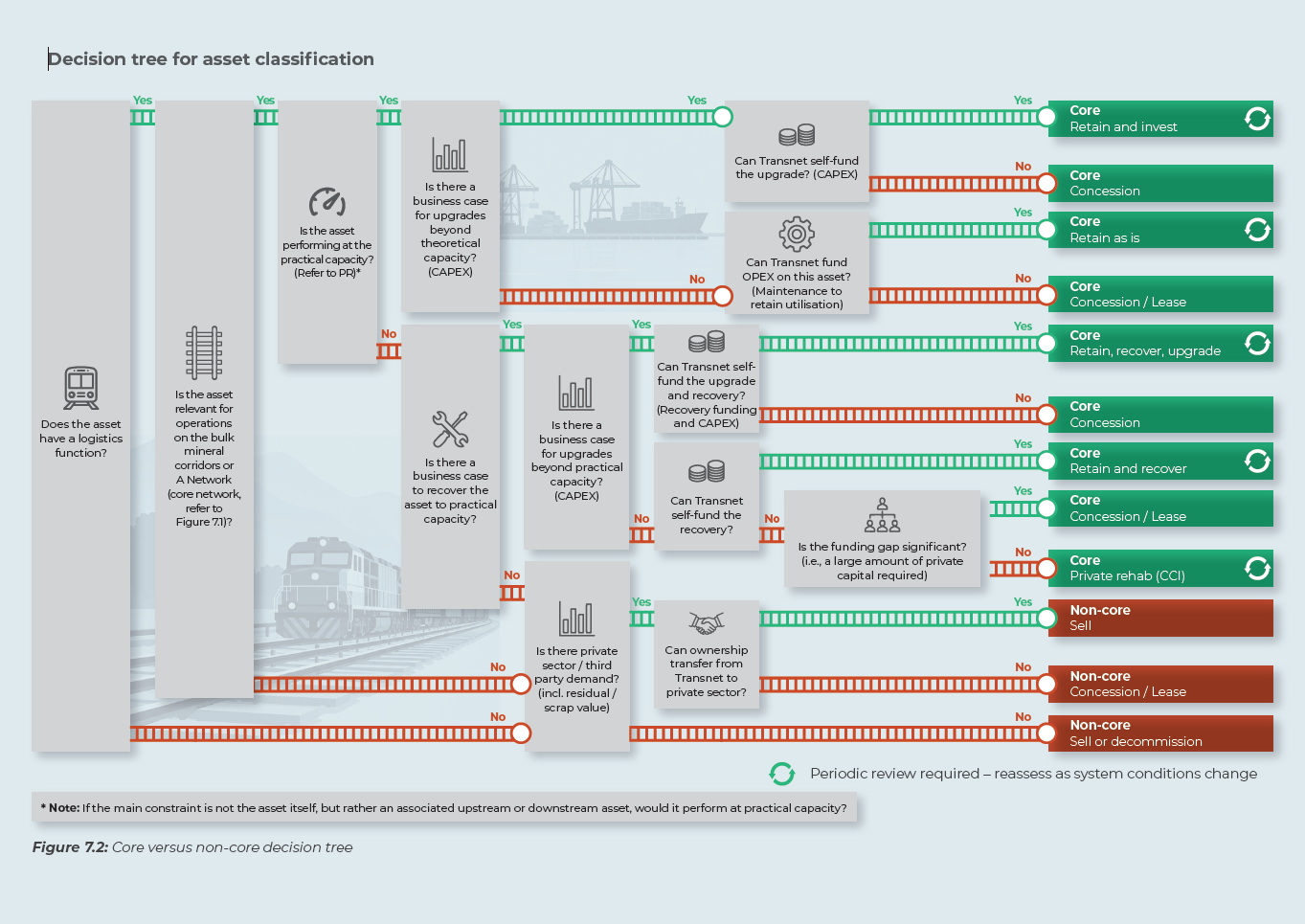
The second volume in our Tracks to Prosperity series, The Future of Transnet's Non-Core Assets, sets out how to decide what happens to each asset. Drawing on interviews with experts across the sector and our own research and analysis, it presents a decision tree that classifies assets by their role and potential, and a framework to guide their disposal or reuse.
Our aim is to provide a fact base to inform the thinking and approach for the Botswana-South Africa Rail Corridor, to share insights and best practices, foster collaboration with those connected to the corridor and others involved in similar infrastructure projects to maximise the corridor’s potential for various industries, regional economies, and the people of Botswana and South Africa.
Volume 2: Download the report
Volume 1: Download the report
At Anura Partners, we believe that rail is one of the key enablers to support the unlocking of Africa’s potential.
African countries are becoming progressively more interconnected, and with the AfCFTA agreements signed, rail corridors to evacuate critical minerals, commodities, and goods to ports are becoming increasingly relevant. As such, dozens of cross-border railway corridor projects are underway in Africa, connecting points deep inland with ports, helping to increase the export of minerals and unlock new mining activities, particularly relevant as critical minerals in Africa are gaining attention. The corridors are in several implementation stages – some are realistic and in planning, while other corridors remain aspirational.
One corridor in particular stands out as being arguably one of the most viable on the continent – the South Africa-Botswana Rail Corridor. Drawing on case studies from across the continent, having interviewed numerous experts across the ecosystem, and undertaking our own research and analysis, Tracks to Prosperity: Realising the vision for the South Africa-Botswana Rail Corridor, explores what it would take to make this corridor a reality.
Our aim is to provide a fact base to inform the thinking and approach for the Botswana-South Africa Rail Corridor, to share insights and best practices, foster collaboration with those connected to the corridor and others involved in similar infrastructure projects to maximise the corridor’s potential for various industries, regional economies, and the people of Botswana and South Africa.

Author


FIND
Office 101aD, 11 Crescent Drive,
Melrose Arch
Johannesburg
•
Gartenstrasse 27, 8853 Lachen, Switzerland
